Been awhile since my last post as I have been preparing other things, but here are some electrostatics problems, detailing the image approach, and solving Laplaces’ equation. I don’t guarantee the validity of the solutions or the approach, so please inform me if you believe you have found an error. I will likely be making a post here soon about an approach to numerically finding solutions to electrostatics problems using the finite difference method, so if you are interested in that please let me know or follow to see the future post.
Blog Feed
Complex Patterns with Spinning Squares
How complex are patterns formed by spinning squares? Not really a question often brought up in conversation, but let’s have some fun with it. I got to thinking, if I took some squares, arranged them in a circle on a table, and spun the table, I should see them perfectly map out a circle. Easy enough to test with enough post-it notes, and sure enough, it’s a circle. Not too surprising. But then I thought, what about if I spun each square individually as I spun the table? I would also want to be able to trace out the path left by each square in order to see a pattern, doing that experiment without regards to tracing is an easy enough thought experiment, but I want to know what patterns it may make. If I had too much time on my hands to build a fancy machine to do this for me, or if I had too many hands I could spin all the squares and trace them at the same time, but neither is true so I resorted to our old friend the computer. In Processing I made my circle of squares, and spun them at the same rate I spun the “table” (my coordinates, in this case), and wound up with the following.
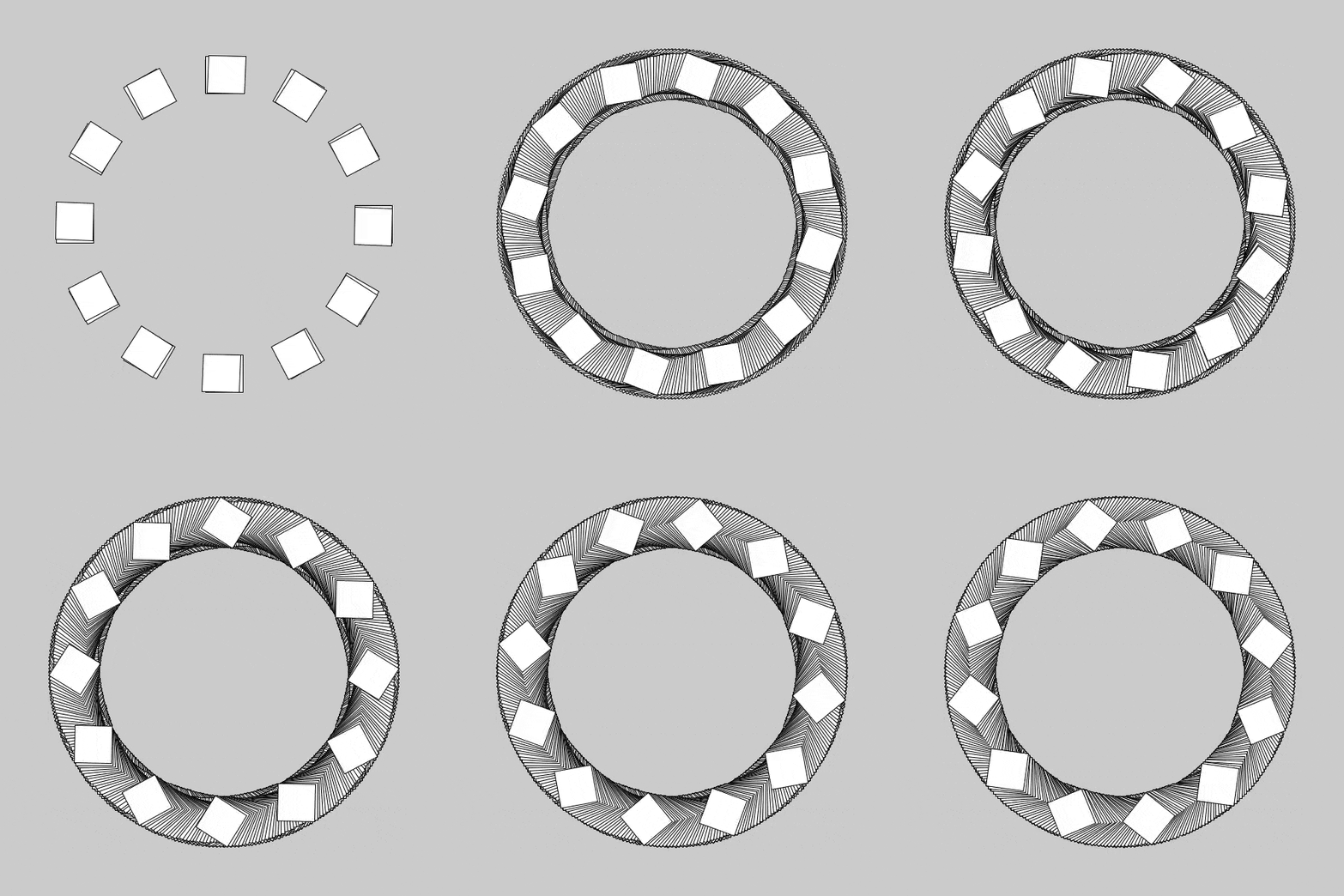
Now that’s cool, even if it’s expected. We can see the corners of the squares trace out circles with progressively increasing radii as the individual square tracks the corner along from inside to outside. In spinning the individual squares while spinning the coordinate space on which they are situated, it is incredibly clear that we create a ring with width being sqrt(2)*sidelength of the square. I thought to myself, naturally, we now have a maximum ring size, but if I change the rate of rotation of the squares with respect to the total rotation, what types of inner patterns will this create(similar to the tracing of the corners)? Well, I began by spinning my table(coordinates) at a great speed compared to that of the individual squares rate of rotation, and sure enough ended up with a different pattern.

Now that’s neat. I managed to get the speed just correct so that way there appears to be no spinning of the table, but have tripled the amount of squares present. Of course, the actual number of squares is the same as the above, but it is now spinning fast enough that it can’t be distinguished. Also, since they don’t appear to move, each individual square maps out its own circle(3 times), creating a “braided” appearance. After that question was answered, I naturally wanted to see the opposite,
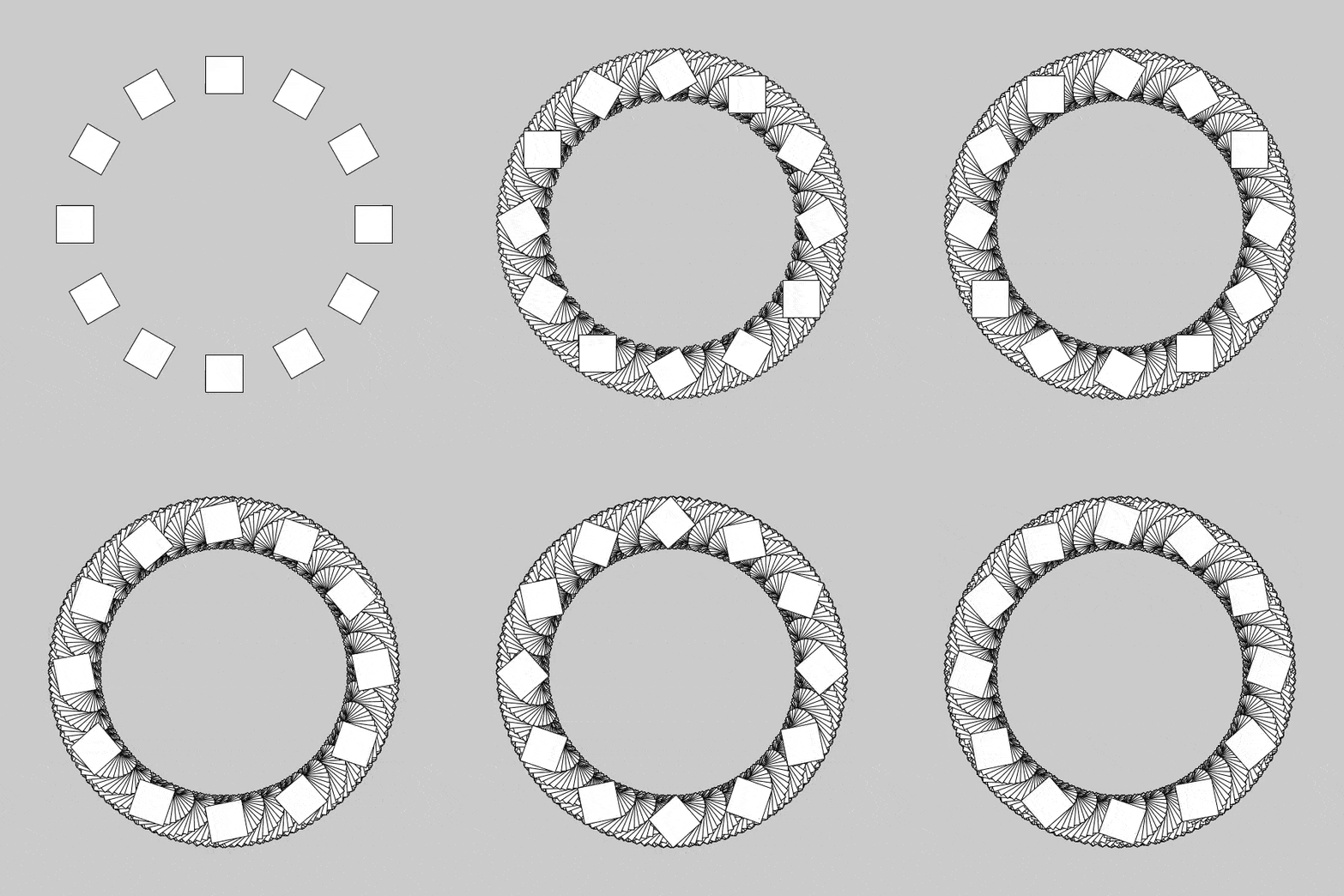
Now, with the individual squares spinning much faster than the table, we are able to more clearly see the arcs that each square maps out during its rotations. The speed of rotation is not perfect, as the previous one, but nearly. You can see the inner radius of our “donut” slowly get populated more and more as time progresses, which I believe if I found the perfect angles of rotation, I could get it to maintain its first initial seashell spiral pattern throughout its entirety. I was still curious regarding these squares, and wanted to see where I could go next. I found a great question in asking whether my patterns would change if I simply changed the pivot location of the individual squares, my guess was yes, but really I wanted to know what types of patterns this would make. I did this, same procedure as above, and found some really interesting behavior, and will likely be posting about that in the next day or so, so stay posted!
Double Quantum Well
For this problem, we investigate the absorption spectra of a coupled double quantum well system. This problem elucidates not only the process of approaching these coupled systems, but also does a good job of how characterization of absorption spectra can be done from experimental data.
Electron Spin
We work through an electron spin in an arbitrary direction, solving for the energy eigenvalues and eigenkets, as well as time evolving the system.
Free Particle
Here we investigate the wavefunction of a free particle, its expectation values both with and without time evolution, of an exponential function of the absolute value of x.
Complex Variables
More worked problems from Arfken, problems 11.6.3 and 11.10.1.
Particle in a Divided Box
Been a while since the last post since I’ve been working on typing up this long problem and have had some other work on my desk, but here is Sakurai 2.10. I make no guarantees of the validity of the result, but this should be an okay guide. This problem essentially gives us a particle in a state described by two wavefunctions, and then has us calculate energy eigenvalues of the system, time evolution, etc. This is a great problem for those still getting used to Dirac notation.
Potential Energy in the quantum SHO
Here I review the SHO from Griffiths, with a touch of Dirac notation. This problem is incredibly useful in highlighting SHO problems and their approach using the creation annihilation operators. I also mean for this to provide a bit of a stepping stone into Dirac notation, while leaving the wave function approach to Griffiths for readers to review to in order to see how this notation actually works.
Transformation Matrix
Here we look at the general idea of how to construct a transformation matrix, for use in quantum mechanics. A transformation matrix works to transform the state in some way, and there can be many different types of transformation operators, which makes them essential to understand. Here, I work through problem 1.26 from Sakurai, trying to provide ample thoughts and insights for the problem. This problem highlights a transformation matrix that transforms the Sz spin basis states to the Sx spin basis states.
Altitude of a Satellite
Here, I continue working through Computational Physics by Newman, showing a solution of the altitude of a satellite problem in Python. The theory behind this problem should be well understood for orbital mechanics, so make sure you work through it.
 laymanphysics.science.blog